Genesis Archive 1967–1975: Opening the Vaults of the Gabriel Era

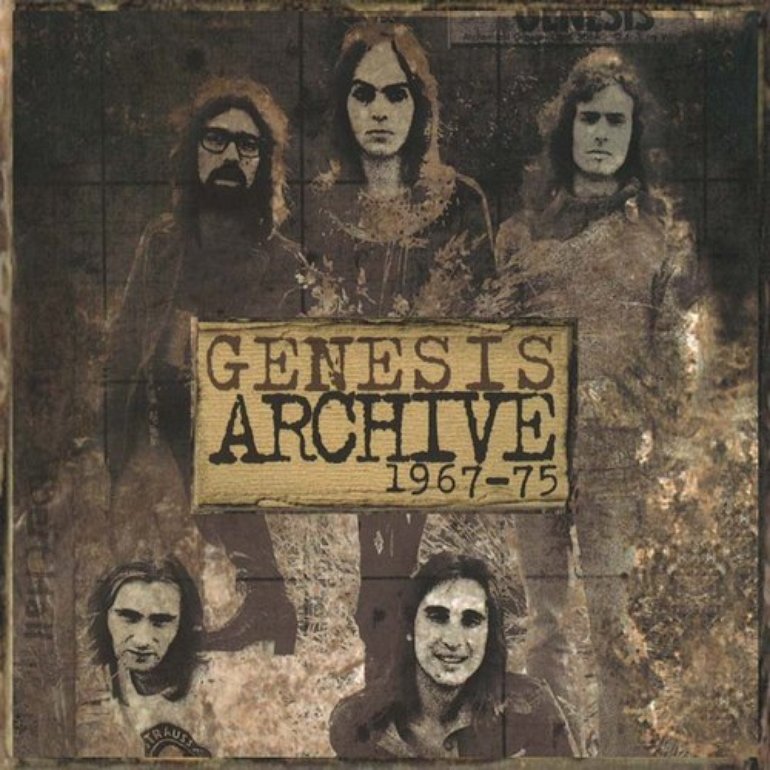
In June 1998, Genesis released the first of their two Archive box sets. Covering the years from 1967 to 1975, Genesis Archive 1967–1975 offered fans an unprecedented look into the band’s formative years and the entire Peter Gabriel era.

A Project Years in the Making

The idea of an extensive Genesis archive release had actually been around since 1994. Originally, the band planned to issue three separate box sets: one covering the Gabriel years, another spanning the late 1970s and early 1980s, and a third focusing on the band’s most commercially successful period from the mid-1980s onwards.

As so often happens with archival projects, plans changed. After several delays, the material was eventually condensed into two releases. The first, Genesis Archive 1967–1975, arrived in 1998. The second, Genesis Archive 2: 1976–1992, followed in 2000 and focused on the Phil Collins era.

Together, the two collections unearthed a wealth of previously unreleased live recordings, demos, B-sides and studio rarities.

The Complete Lamb Lies Down on Broadway Live Performance

The first two discs of Archive 1967–1975 are devoted to a complete performance of Genesis’s masterpiece, The Lamb Lies Down on Broadway.

During the band’s 1974–75 tour, the entire double album was performed live each night. Shortly after the tour ended, Peter Gabriel left Genesis, making these recordings particularly significant.

The performance featured on the box set was recorded at the Shrine Auditorium in Los Angeles. While it finally gave fans an official release of the complete Lamb show, one element was largely missing: many of Gabriel’s famous storytelling interludes between songs were edited out.

Revisiting the Past

The recording is not entirely untouched. In 1995, Peter Gabriel and Steve Hackett returned to add new vocal and guitar parts where the original tapes required restoration.

Gabriel recorded his contributions at his Real World Studios, and attentive listeners can often hear the difference between his 1970s voice and the one heard on the archive release. Another unavoidable limitation was the ending of “It,” which fades out because the original tape ran out before the song had finished.

Despite these alterations, the performance remains remarkable. The band sounds powerful and confident, while the audience’s enthusiasm is palpable throughout.

For the most part, the songs closely follow their studio counterparts. The major exception is “The Waiting Room,” the album’s experimental instrumental section, which was improvised differently each night. Highlights include the title track, “Fly on a Windshield,” and an especially moving version of “The Carpet Crawlers.”

Selling England Live at the Rainbow

Disc three shifts focus to the Selling England by the Pound tour of 1973, drawing primarily from performances recorded at London’s Rainbow Theatre.

For many fans, this was one of the most exciting aspects of the release. At last, official live versions of classics such as “Dancing with the Moonlit Knight” and “Supper’s Ready” became available with Peter Gabriel on lead vocals.

Unlike the Lamb recordings, Gabriel’s stage introductions and stories were preserved here, offering a valuable glimpse into Genesis’s legendary live performances of the early 1970s.

The disc also includes the band’s 1971 BBC recording of “Stagnation,” alongside non-album gems such as “Twilight Alehouse” and “Happy the Man.”

The Hidden Treasure: Disc Four

For many longtime fans, the fourth disc is the true jewel of the collection.

Dedicated to Genesis’s earliest years with guitarist Anthony Phillips, it features BBC sessions, demos and rare recordings from a period when the band’s identity was still taking shape.

Listening to these recordings feels like hearing Genesis becoming Genesis.

Among the highlights are early versions of songs that would later evolve into familiar classics, alongside lesser-known tracks such as “Hey!” that reveal a gentler, more pastoral side of the band’s music.

There is a distinctive atmosphere running through these recordings, one that many listeners associate with Anthony Phillips’s influence and which largely disappeared after his departure in 1970.

Some casual listeners may find this disc the most challenging, but for dedicated fans it is arguably the most rewarding.

A Comprehensive Package

Beyond the music itself, the box set included an impressive 82-page booklet featuring an extensive band history, rare photographs and interviews with members of Genesis and their associates.

The collection finally provided official live recordings of many Gabriel-era favourites. Prior to its release, the only official live album featuring Gabriel had been Genesis Live (1973), which covered material primarily from Trespass, Nursery Cryme and Foxtrot.

The inclusion of B-sides and previously unreleased songs such as “Twilight Alehouse” added even more value. Although some known demos and rarities remained absent from the final selection, Archive 1967–1975 was widely regarded as an extraordinary release.

Fans clearly agreed: the box set reached No. 35 on the UK Albums Chart.

A Rare Reunion at Heathrow

To promote the release, Genesis staged a remarkable reunion photo session at Heathrow Airport in May 1998.

Present were Tony Banks, Peter Gabriel, Mike Rutherford, Phil Collins, Steve Hackett, Anthony Phillips and original drummer John Silver. Even the band’s very first drummer, Chris Stewart, attended the dinner that followed the photo shoot.

Only Trespass-era drummer John Mayhew was absent.

For fans, the images were almost as exciting as the music itself: a rare gathering of nearly every significant figure from Genesis’s history.

Looking Ahead

The success of Archive 1967–1975 paved the way for a second collection. Released in 2000, Genesis Archive 2: 1976–1992 explored the Phil Collins era and completed the band’s ambitious effort to open its vaults.

More than twenty-five years later, Archive 1967–1975 remains an important release in the Genesis catalogue: a fascinating journey through the band’s early years and an essential document of the Peter Gabriel era.
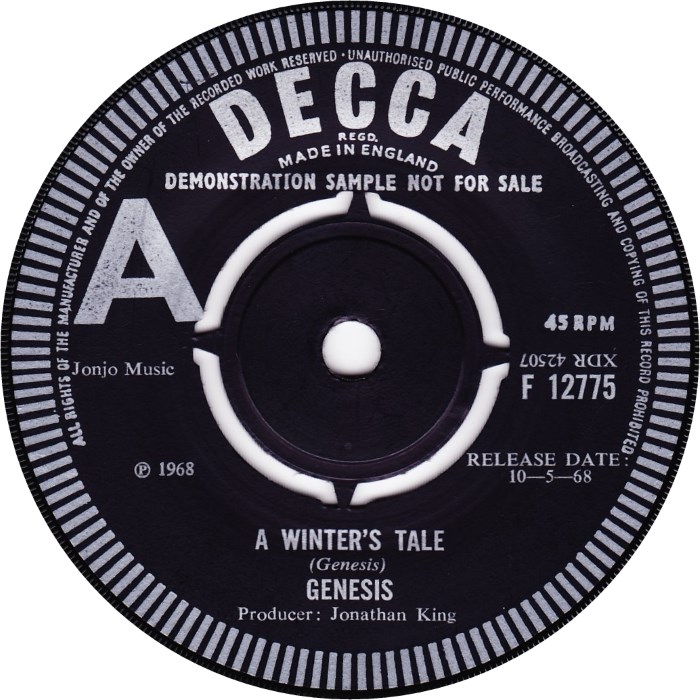
A Winter’s Tale (1968) – Genesis

On 10 May 1968, Genesis released their second single. Like its predecessor – and its successor – it failed to make an impact. Here’s the story behind A Winter’s Tale.

In 1968, Genesis were still schoolboys. The four classmates from Charterhouse were in their late teens when producer Jonathan King offered them a record deal. Tony Banks (keyboards), Peter Gabriel (vocals), Anthony Phillips (guitar), Mike Rutherford (guitar and bass), and Chris Stewart (drums) agreed. King chose to produce their first album himself, and it was he who came up with the name “Genesis,” symbolising both the band’s beginning and the start of his own career as a producer.

The first singles

Genesis had been writing pop songs while still at school, but by the time they signed their deal, they were already moving towards more adventurous material. Jonathan King, however, preferred straightforward pop. So, to please him, Tony Banks and Peter Gabriel wrote The Silent Sun, a deliberate nod to the Bee Gees, which King loved and released as their debut single. It flopped.

A Winter’s Tale

For their second single, A Winter’s Tale, Tony Banks and Peter Gabriel again collaborated. Like The Silent Sun, it’s a love song, but here, the band sounds more confident, particularly in the soaring chorus. Once again, Peter Gabriel’s distinctive voice takes centre stage, rising above a lush (and somewhat overpowering) string arrangement. Even at this young age, Gabriel’s vocal strength hinted at the frontman he would soon become.

Unfortunately, A Winter’s Tale also failed to chart. It received little radio play and only a couple of published reviews. New Musical Express praised the song’s “pulsating crescendo” and thoughtful lyrics, but continued: “The melody could have done with a little more substance.”1

Mike Rutherford recalls in his autobiography that the band brainstormed ways to boost airplay. Peter Gabriel suggested they hand the single directly to BBC Radio 1 DJ Tony Blackburn. Tony Banks was tasked with waiting outside Broadcasting House. Nervous and unsure, he apparently came across a little too forcefully when Blackburn emerged – likely startling him and not helping their cause.2

From Genesis to Revelation

Shortly after the release of A Winter’s Tale, drummer Chris Stewart left the band and was replaced by John Silver, who would record their debut album From Genesis to Revelation. The album was an ambitious concept piece about the history of mankind, but musically, it still leaned far more towards soft pop than progressive rock. To the band’s disappointment, King added even more lush string arrangements, giving the album a gentle, almost easy-listening feel.

A third single, Where the Sour Turns to Sweet, followed, but like the others, it failed to chart. Eventually, the growing divide between King’s pop sensibilities and the band’s evolving musical ambitions led them to part ways.

What remains from this era is a fascinating and surprisingly strong collection of songs recorded by a band still in their teens. Among them is A Winter’s Tale, a glimpse of what was to come.

(And as a footnote for collectors: there’s a curious story about a cover version of A Winter’s Tale by Rita Pavone’s brother – but that’s a tale for another time.)

  1. Thompson, Dave, Turn it on again. Peter Gabriel, Phil Collins & Genesis. (San Francisco: Backbeat Books, 2005), p. 18 ↩︎
  2. Rutherford, Mike (2014): The Living Years. London: Constable, p. 48. ↩︎

The Silent Sun (1968) – Genesis

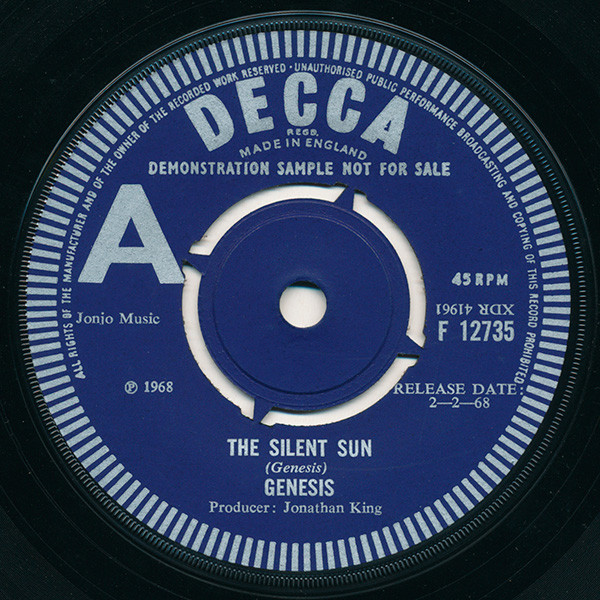
In February 1968, Genesis released their debut single, The Silent Sun, on Decca Records. At just 17 years old, Peter Gabriel was already making his mark. Let’s take a closer look at the band’s very first single!

Genesis at Charterhouse

In 1968, Genesis were still students at Charterhouse School. Tony Banks, Peter Gabriel, Mike Rutherford, and Anthony Phillips had formed the band as a way to escape the constraints of school life. At the time, the group operated as two songwriting pairs: Banks and Gabriel on one side, Phillips and Rutherford on the other.

While still at school, they recorded demos and sent them to Jonathan King, a former Charterhouse student who had found success as a musician and producer (his best-known hit being Everyone’s Gone to the Moon). King was particularly impressed by Peter Gabriel’s voice and signed them to Decca Records, intending to produce a full album. However, when the band presented their next batch of demos, he wasn’t impressed.

A Producer Who Loved The Bee Gees

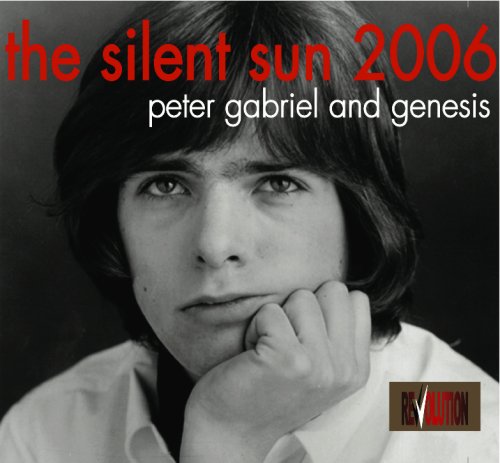
Jonathan King wanted the band to deliver a potential hit. Knowing he was a fan of The Bee Gees, Peter and Tony deliberately wrote a song in their style—The Silent Sun.

‘I tried my best Robin Gibb impersonation,’ Peter later joked.1

King loved it and made it their debut single, later including it on the band’s first album, From Genesis to Revelation.

Musically, The Silent Sun blends folk and pop, with Tony Banks’ piano already playing a central role. The song primarily highlights Peter’s vocals, with orchestral strings added later by King in the studio. It’s also one of the rare official Genesis recordings to feature their original drummer, Chris Stewart.

‘We had been drilled by Jonathan King to write short pop songs, which I resisted,’ Anthony Phillips recalled. ‘I didn’t like The Silent Sun at all.’ He later reflected that it was probably for the best that the song wasn’t a hit: ‘If it had been successful, the band would never have developed its proper style.’2

Tony Banks, however, believed it had the potential to be a great hit. For Peter Gabriel, seeing the name Genesis in Record Mirror was a career-defining moment, while Mike Rutherford fondly remembers the thrill of hearing The Silent Sun on the radio for the first time in Anthony Phillips’ kitchen.

Reviews and Reception

Upon release, the Decca catalogue described The Silent Sun as ‘quietly attractive.’’.3 New Musical Express praised its ‘beautiful flowing arrangement of violins and cellos,’ though they speculated it ‘might be a bit too complex for the average fan.’4

A Single That Failed but a Band That Flourished

Despite their enthusiasm, The Silent Sun failed to chart. The accompanying album, From Genesis to Revelation, was also a commercial failure. Eventually, Genesis parted ways with Jonathan King, allowing them to explore a more adventurous and distinctive musical direction.

As the band gained fame, King repeatedly re-released these early recordings in various formats, capitalizing on Genesis’ later success. But for Genesis themselves, The Silent Sun remains a fascinating footnote in their history—their first step on the road to greatness.

Sources

ANTHONY PHILLIPS FULL UNCUT INTERVIEW .PT 1:FORMING GENESIS/ EARLY RECORDING/DISCOVERING THEIR SOUND.

Decca Press release.

GENESIS REUNION 2014: THE THREE. Part ONE. NOW FULL UNCUT VERSION ! + improved audio!

Thompson, Dave, Turn it on again. Peter Gabriel, Phil Collins & Genesis. (San Francisco: Backbeat Books, 2005).

  1. GENESIS REUNION 2014: THE THREE. Part ONE. NOW FULL UNCUT VERSION ! + improved audio! ↩︎
  2. ANTHONY PHILLIPS FULL UNCUT INTERVIEW .PT 1:FORMING GENESIS/ EARLY RECORDING/DISCOVERING THEIR SOUND. ↩︎
  3. Decca Press release. ↩︎
  4. Thompson 2005: 17. ↩︎